A postcard is one of the few printed pieces where a quarter inch of trim decides how much every card in the run costs to mail. The U.S. Postal Service has a precise definition of what qualifies for the discounted postcard rate, and a card that drifts even slightly outside those limits quietly jumps to letter pricing. If you are ordering thousands of cards, understanding the size and postage rules before you approve artwork is the difference between the budget you planned and a bill that runs meaningfully higher.
What the USPS actually calls a postcard
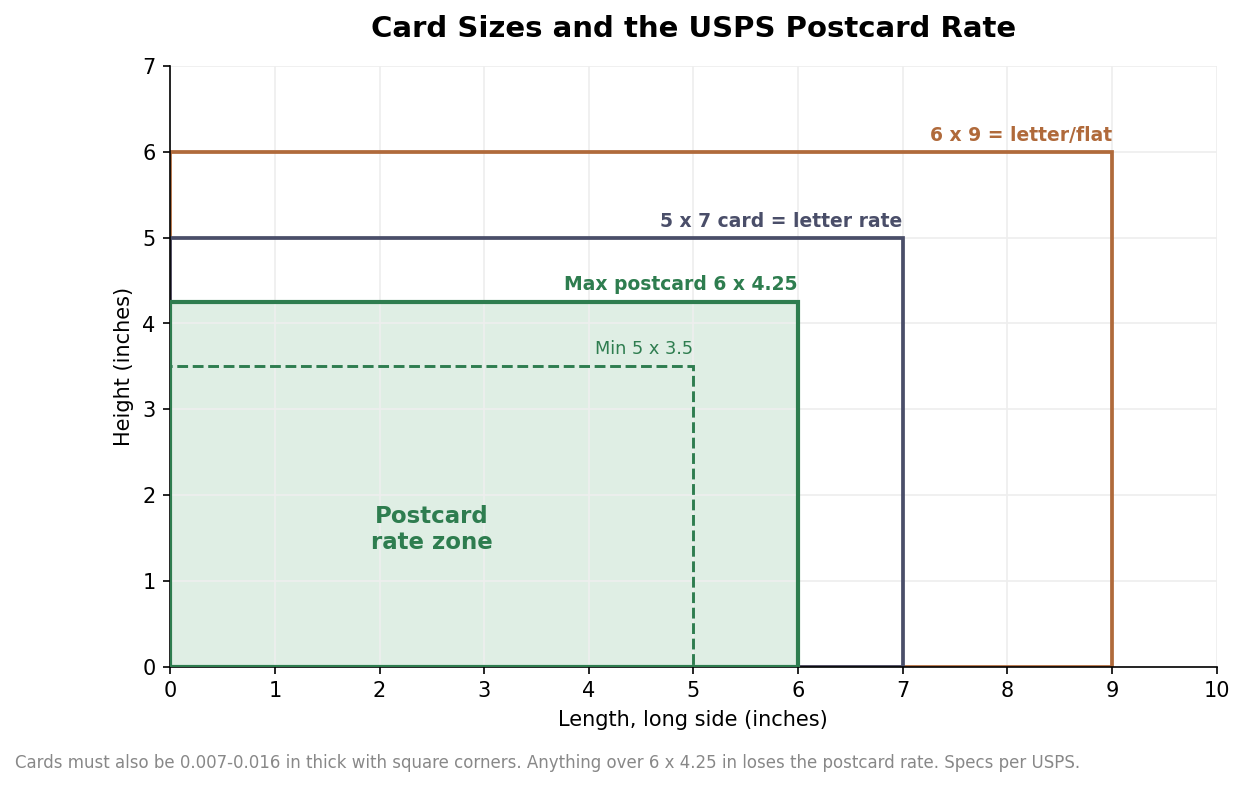
To mail at the postcard rate, a card has to sit inside a specific window. It must be at least 3.5 by 5 inches and no larger than 4.25 by 6 inches, and it must be between 0.007 and 0.016 inches thick. It also has to be rectangular with four square corners and parallel opposite sides. Miss any one of those and the piece is no longer a postcard in the eyes of the Postal Service, regardless of what the design looks like or how the printer markets it.
This is where the popular 5-by-7 card trips people up. It looks like an oversized postcard and is often sold as one, but because it exceeds the 4.25-by-6 maximum, the USPS treats it as a First-Class letter and prices it accordingly. The classic 4-by-6 card, by contrast, sits comfortably inside the window, which is a large part of why it remains the default for direct mail. If holding the postcard rate matters to your campaign, design to 4 by 6 or, at most, to the 4.25-by-6 ceiling.
What each size tier costs
The gap between tiers is not trivial. USPS prices a single-piece First-Class postcard lower than a one-ounce First-Class letter, and that difference looks small on one card but turns into real money at scale: on a mailing of thousands of pieces, letting the card slip into letter pricing adds a large amount in postage alone, before you account for any change in paper or printing. The size rule is, in effect, a pricing rule, and it rewards designing to spec.
Those are retail single-piece rates, what you pay sticking stamps on cards one at a time. They are the ceiling, not the floor. The Postal Service reprices the same physical card substantially lower once you mail in volume and do some of the sorting work yourself, which is where most business postcard programs actually live.
How bulk and EDDM change the math
Mail at least 200 pieces or 50 pounds and you can enter the card as USPS Marketing Mail, where automation-compatible letters and cards sort for well under half the retail letter price at the deepest 5-digit automation tier. The trade is preparation: you need a mailing permit, cleaned and standardized addresses, an Intelligent Mail barcode, and pieces that meet automation requirements. Every Door Direct Mail takes a different route, letting you blanket entire postal carrier routes without a mailing list, with no permit required for the retail option. EDDM favors local saturation, which is why it suits a neighborhood service business, while a targeted list favors Marketing Mail. Both cost far less per card than retail, but both come with minimums, prep work, and format rules that your card has to respect from the design stage forward.
It is worth choosing the mail class before you choose the size, because the two decisions interact. A larger 6-by-9 or 6-by-11 card cannot ride the postcard rate, but it can still be economical as saturation EDDM, where the bigger canvas earns attention and the per-piece cost stays low. A compact 4-by-6 card is the cheapest way to reach a targeted First-Class or Marketing Mail audience. The mistake is designing a beautiful oversized card first and only then asking how it mails, at which point your only options are to accept letter pricing or reprint. Deciding the class and size together keeps the creative and the postage pulling in the same direction.
Designing a card that mails at the rate you want
Start the design from the postage tier you are aiming for rather than discovering the tier after the cards are printed. If you want the postcard rate, lock the trim size at 4 by 6 or 4.25 by 6 and pick a stock that lands inside the 0.007-to-0.016-inch thickness range, since an unusually heavy cover stock can technically push a card out of postcard territory. Keep the lower-right portion of the address side clear for the address block and barcode, leave the required clear zones the USPS specifies for automation, and avoid design choices like rounded corners or unusual aspect ratios that can trigger a nonmachinable surcharge on letter-size pieces. If you are going the bulk or EDDM route, confirm the exact clear-zone and barcode placement rules for that mail class before you finalize the layout, because retrofitting an address panel onto an approved design is a headache you can avoid entirely by planning for it.
One caveat worth repeating
Postal rates change, and they have moved more than once in recent years. The exact rate you pay depends on the current schedule, your mail class, your sort level, and your entry point, so confirm the live rate with the USPS or your mail house before you commit a budget. The size and shape rules are far more stable than the prices; a card designed to the 4-by-6 or 4.25-by-6 postcard window will keep qualifying for the postcard tier even as the rates attached to it drift over time. For a quote on printing your postcards to spec, send your details through the quote form.